Your employees break into
the security team's office.
And learn everything
in the process.
A portable, physical escape game we bring directly to your office. No travel required from your team. No software to install. Just 30 minutes that your people will still be talking about next week.
Tight enough to keep adrenaline high. Long enough to cover every major threat vector.
Small groups encourage real collaboration. Multiple sessions run back-to-back across a full day.
We bring everything — laptops, props, screens, lighting, crime scene tape, lock-picking kits. You provide three tables and your people.
Fully localised. Run in English, German, or French — or mix languages across sessions on the same day.
They skipped the security training.
Now they have to sneak their way in.
Players take on the role of employees who, to avoid a mandatory — and notoriously boring — security seminar, decide to break into the security team's office and add themselves to the attendance list.
The twist: to do it, they'll have to solve every security puzzle in the room. By the time they reach the final laptop and save the file, they've encountered phishing emails, suspicious USB drives, weak credentials, physical security vulnerabilities, and social engineering traps. They've reasoned through all of them — together, under time pressure, laughing the whole way.
That's the learning. They just didn't see it coming.
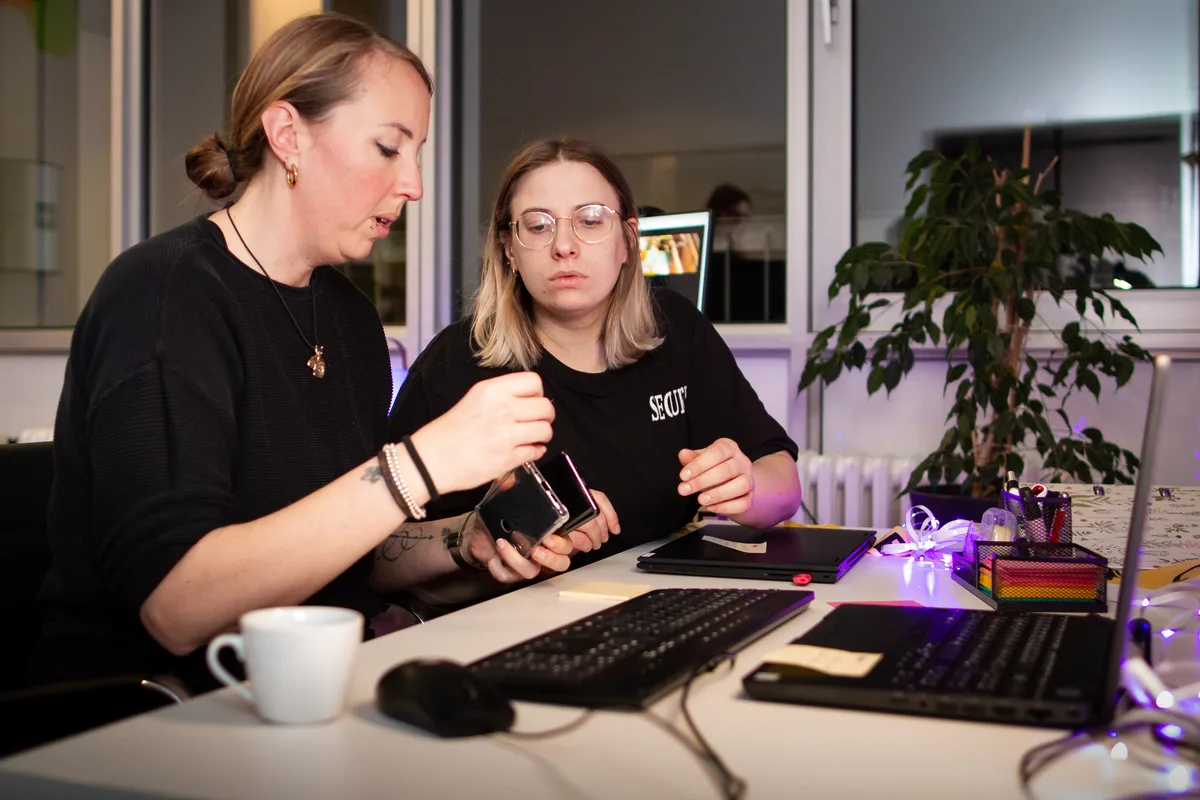
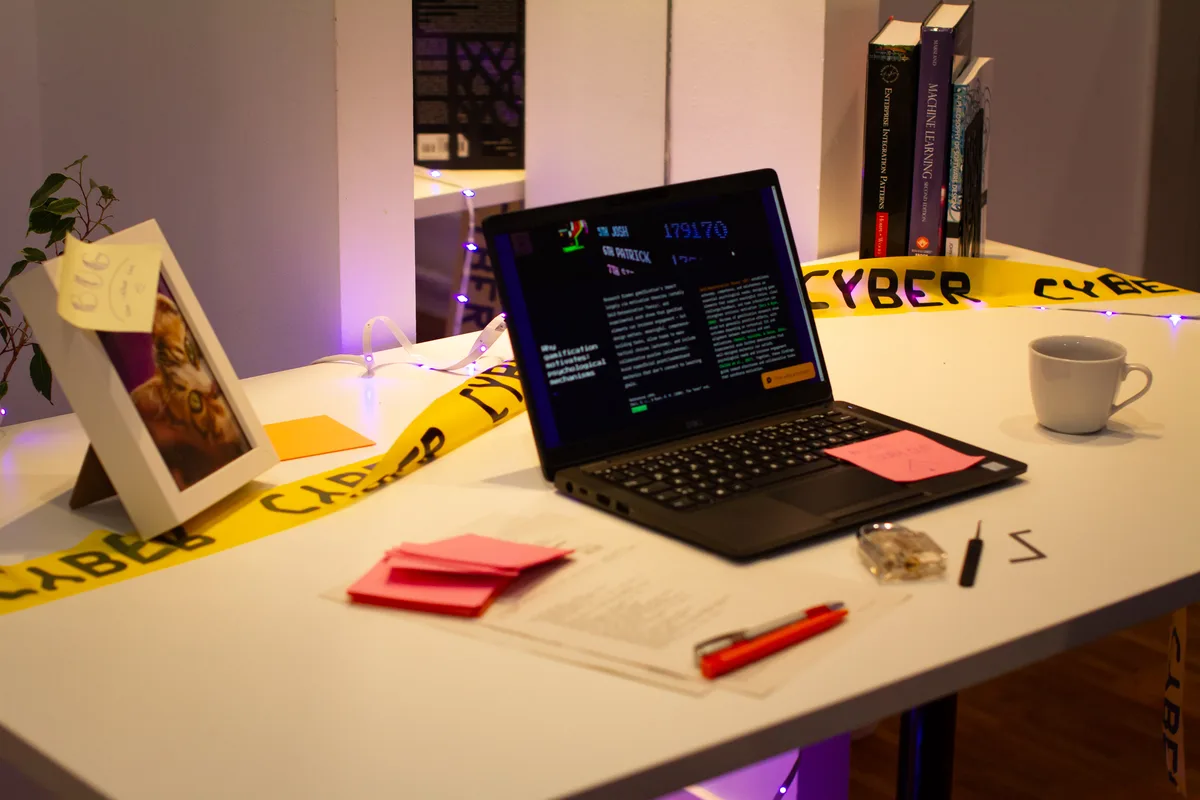
We turn your meeting room
into a cyber crime scene.
When we arrive, we set up a complete, self-contained escape room environment in any available space — a conference room, an open office area, a training room. The atmosphere is the point: purple and cyan lighting, "CYBER" crime scene tape marking the perimeter, screens running our custom game interface, props scattered across desks like clues in a real investigation.
Players interact with everything in the room:
- A laptop running the game interface — the final objective the team is working towards
- Realistic phishing emails printed and placed as physical props
- USB drives with labelled "suspicious" content to reason through
- A lock-picking puzzle as an optional sidequest, tied to a bonus clue chain
- Social engineering scenarios embedded in prop documents and notes
- A timer — visible, counting down, generating just enough pressure
Real threats. Real scenarios. Real habits.
SecuriQuest scenarios are built around the security threats employees encounter every day — not abstract theory. Every puzzle maps to a real attack vector.
Phishing recognition
Identifying malicious emails, spoofed senders, and social engineering attempts embedded in realistic office communication.
Password & credential hygiene
Understanding the risks of weak passwords, credential reuse, and the basics of secure authentication practices.
Physical security threats
Recognising the danger of unknown USB devices, unlocked screens, and physical access vulnerabilities in the office.
Social engineering
Learning to identify manipulation techniques used by attackers — impersonation, urgency cues, and trust exploitation.
Data handling
Proper handling of sensitive documents, access control awareness, and understanding of data classification principles.
Incident reporting
Understanding when and how to report a suspected security incident — the most critical and most undertrained behaviour.
Five steps. One lasting shift.
Every SecuriQuest engagement follows a structured methodology — from first contact to long-term behaviour change. Here's how it works. Full methodology →
Discovery & risk identification
We start with a conversation to understand your organisation — your industry, your compliance obligations, the profiles and roles of participants, and the specific security behaviours you want to reinforce or change. This is a genuine needs assessment, not a product demo.
Preparatory briefing to participants
Before the session, every participant receives a short, carefully written briefing email. It introduces the key security concepts they'll encounter in the game — not to spoil the experience, but to prime their thinking. Available in English, German, and French.
The escape game session
We arrive at your location, set up the portable game, and run the session. Groups of up to 8 players work together against the clock to identify and neutralise security threats embedded in realistic office scenarios. Players discover security vulnerabilities by reasoning through them together — not by reading about them.
Expert debrief
Immediately after each session, a SecuriQuest security expert leads a structured debrief. This is where learning is consolidated: we discuss what threats were encountered, which were caught, which slipped through, and what that means for daily work. The debrief converts the emotional experience of the game into concrete, actionable security habits.
Learning summary & compliance documentation
Every participant receives a take-home summary of what they learned and the key security behaviours to apply daily. For Enterprise clients, we produce a compliance report documenting the training against the relevant standard — audit-ready, mapping to ISO 27001, NIS2, SOC 2, C5:2020, or on request.
Compliant with the frameworks that matter.
Every SecuriQuest session is designed to meet the security awareness requirements of the standards your organisation is accountable to.
Frequently asked questions
How many people can play at once?
The Escape Game is designed for teams of 2 to 8 players per session. For larger groups, SecuriQuest can run multiple back-to-back sessions in a single visit — there's no limit to the total number of participants in a day.
Do we need to prepare anything before the session?
Nothing at all. SecuriQuest brings all equipment, sets up the scenario, and manages the full session. You provide a quiet room for 30 minutes. That's it.
Is this suitable for non-technical employees?
Yes — deliberately so. The Escape Game is designed for everyone, not just IT or security teams. The scenarios are grounded in everyday situations (phishing emails, USB drives, suspicious messages) that any employee can encounter. In fact, non-technical players often spot things that technical players miss.
In which languages is the game available?
The SecuriQuest Escape Game is available in English, German (Deutsch), and French (Français). The language can be set per session, making it ideal for multilingual teams.
What's the difference between the Escape Game and Beat the Clock?
The Escape Game is a cooperative puzzle: your team works together to follow a chain of clues through a simulated breach. Beat the Clock is a competitive threat-hunt: your team sweeps a pre-seeded environment, scoring points for threats neutralised and losing points for traps triggered. Both run in 30 minutes; Beat the Clock adds a public leaderboard element.
Ready to bring it to your team?
Tell us your team size, location, and preferred timing. We'll come back within one business day.